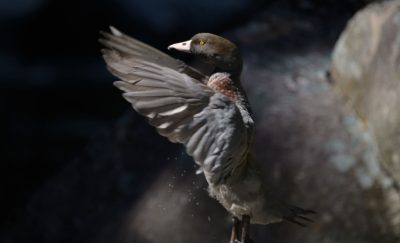


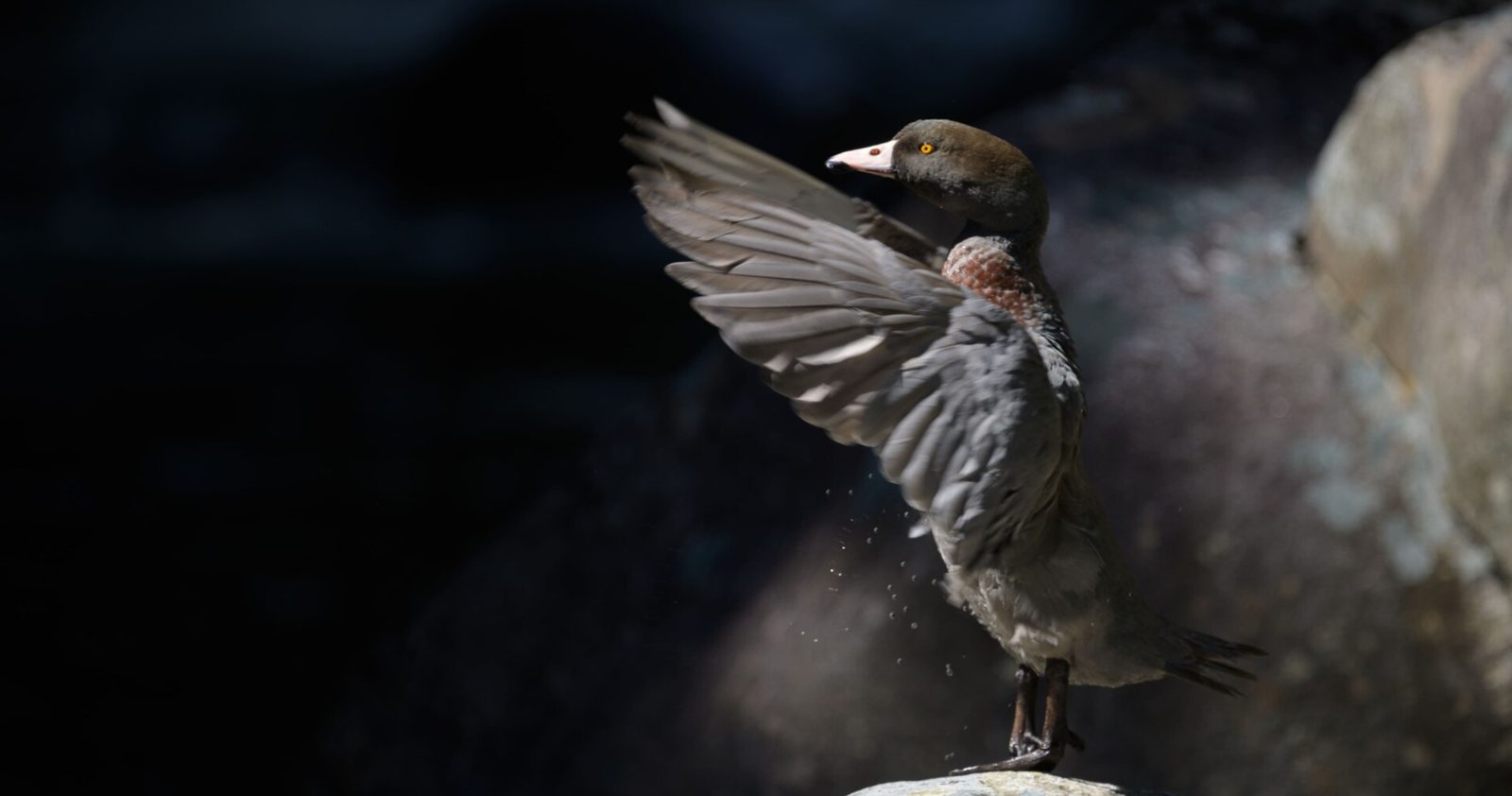
Whio / Blue Duck

Whio DecLB  o
Photography by Leon Everette
The mission

The bird that lives where almost nothing else can

Whio live in the cold, fast water of New Zealand’s back-country rivers, in environments other ducks wouldn’t dare dip their feet in. The male gives a high whistle, the female a low growl, and where you can still hear them the river is healthy. Around 2,500 to 3,000 are left, and stoats take nesting females and ducklings faster than the birds can replace them. Where predator control is sustained, whio come back. Your support keeps that work going on the river.


The species

A treasured species with no close living relatives anywhere on earth.

Whio are one of the world’s most specialised waterfowl, adapted to live in cold, fast mountain rivers – the male’s whistle an iconic sound now missing from many back country rivers. They are an evolutionary relic, the only member of their genus, with no close living relatives anywhere on Earth. Each pair holds about a kilometre of river as its territory, year-round, feeding in flowing water and raising broods on the same stretch where they hatched. Their presence is a sign of a healthy river. Where whio thrive, the freshwater system is intact.

Whio are taonga, treasured by Māori, with cultural and spiritual connections to tangata whenua and to the awa throughout Aotearoa. They appear on New Zealand’s ten-dollar note, an acknowledgement of their place in the national story.

The challenge

Whio are classified Nationally Vulnerable.

An estimated 2,500 to 3,000 remain, perhaps 1,200 pairs at most, and the population is still declining. North and South Island whio are genetically distinct and managed as separate populations, so losses in one island cannot be made up from the other.

Stoats are the single biggest driver of decline, preying on nesting females, eggs and ducklings. Without management, nest failure can reach 91 percent. Cats and ferrets are an emerging concern, potentially linked to unexplained declines, and now flagged as a research priority. Flooding, made worse by climate change, washes out nests and breaks up broods.

Unlike many threatened species, whio cannot be moved to predator-free islands. No island in New Zealand has rivers large enough to support them. Their survival depends entirely on managing threats in remote mainland rivers, which makes them one of the hardest species to protect.

What your support funds

Your donation strengthens and expands this work at a critical time.

Predator prevention

More predator control in high-risk areas, through additional traps and improved techniques, to hold the stoat suppression whio depend on.

Early detection

Monitoring and adaptive management so declines are caught early and management can adjust quickly.

Research and development

Research into understanding management approaches for success.

Whio NovLB  Edit o Whio NovLB  Edit o
Whio cd  O

Why it matters

Whio are an ancient lineage with no close relatives, shaped over millions of years for a life almost no other bird attempts. They are also a living gauge of river health. Where they persist, the ecosystem is working, and where they disappear, something fundamental has gone with them. DOC’s monitoring shows that where effective stoat control is in place, whio numbers can rise almost three-fold within four years. Where the control stops, they fall. With your support, the whistle and the growl stay on the river.

Photography by Leon Everette.

Project partners

Partnership & governance

Take action

When we act, whio recover. When we stop, they vanish.

Whio DecLB  o Learn how

Donate to help us save the precious whio

Every dollar protects another stretch of wild river, and keeps whio on it.

Donate now
Whio DecLB  o Learn how

Share this project with people who care

Every share helps more people discover the work being done to save the whio.

Share on LinkedIn

Whio recovery is led by the Department of Conservation under its Managing Threatened Species programme, with support from Genesis Energy (Whio Forever) and Horizons Regional Council (Kia Wharite). NZ Nature Fund manages charitable donations for this project. NZ Nature Fund holds donations in a dedicated charity account and disburses against project milestones. All operational delivery sits with DOC. All gifts are tax-deductible in New Zealand. Registered Charity CC32894.

Photography by Leon Everette.

Stay connected
Be the first to hear about project updates, opportunities, and stories from the wild.
Invest
Subscribe for updates

Subscribe for updates

Sign up to hear the latest news and updates from New Zealand Nature Fund.